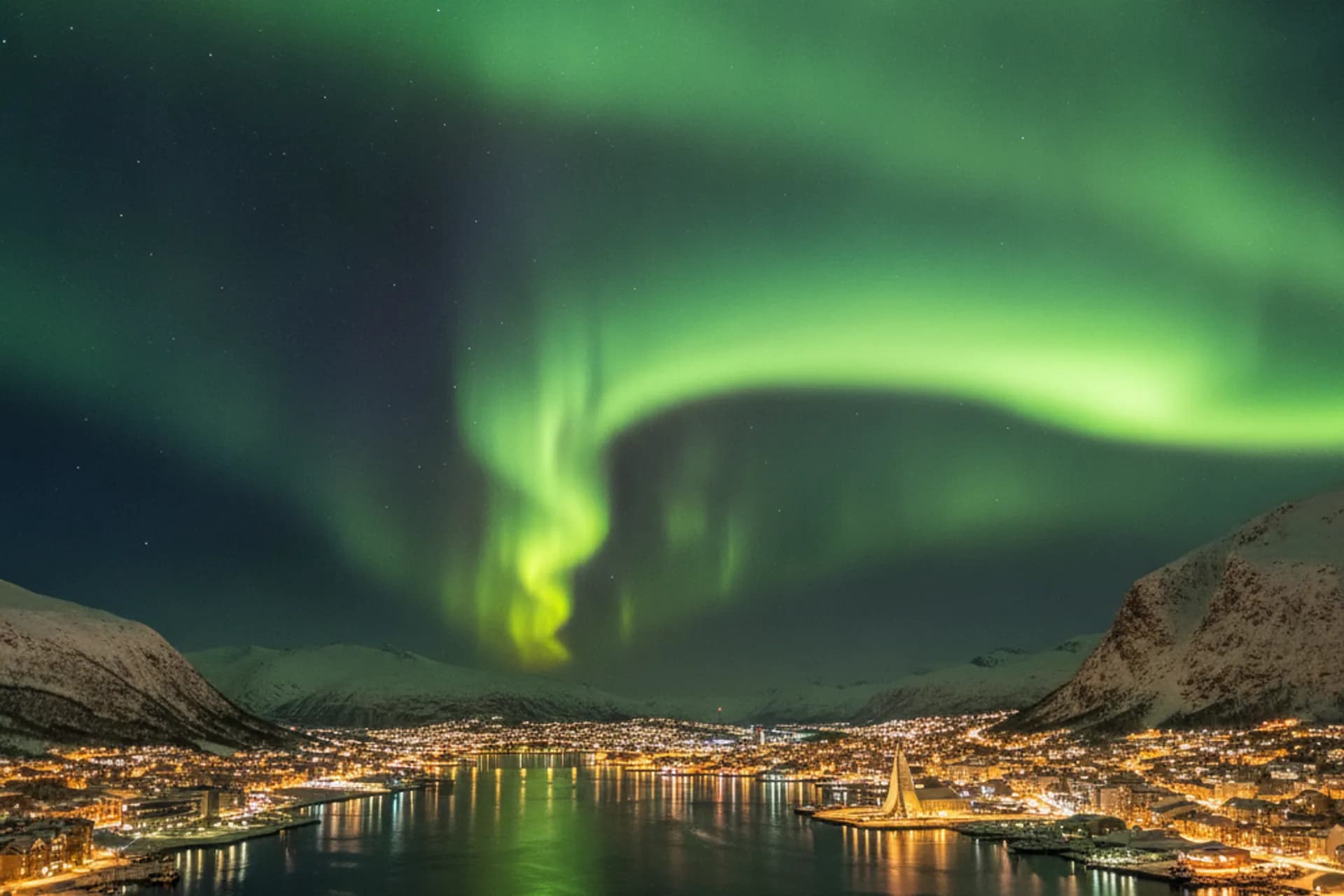
Northern Lights in Norway: when, where & how to see them from the water
The northern lights are Norway's most sought-after winter spectacle, and the far north of the country sits directly beneath the belt where they appear most often. This guide covers the honest essentials: when the season runs, where your odds are highest, and why watching from a boat can beat standing on a cold shoreline.
We keep the numbers real. No tour operator can promise the aurora, but a little planning around the season, the moon and the weather turns a lucky sighting into a likely one. Here is everything you need to plan a trip built around the lights.
What the northern lights actually are
The aurora is caused by charged particles from the sun striking gases high in the atmosphere, making them glow — green from oxygen, with hints of red and violet. The activity is measured on the KP index, a 0–9 scale of geomagnetic strength: even a modest KP 2–3 is enough for a good show in the far north.
That is because the lights concentrate in a ring around the magnetic pole called the auroral oval. Northern Norway lies inside or just under this oval, so you do not need a rare solar storm to see them — on a clear, dark night the aurora is often overhead.
When to go: the aurora season
The season runs from around 25 August to 5 April, whenever the nights are long and dark enough. It peaks from November to February, when darkness is deepest. January is the strongest single month, with clear-sky odds of roughly 75–80% of seeing the lights on a well-timed multi-night trip to Tromsø.
Give yourself several nights rather than one. The aurora is unpredictable night to night, so three or four evenings in the region dramatically improve your chances of catching a clear, active sky.
Three factors that decide your night
- Darkness: you need a properly dark sky, so avoid the weeks around midsummer entirely — there is no aurora season in the light half of the year.
- The moon: a bright full moon washes out faint displays. Around a new moon the sky is darkest and even weak aurora stands out.
- Clouds: the single biggest spoiler. The lights are always above the clouds, so a clear gap in the weather matters more than a high KP number.
When to go?
- Northern lights
- Midnight sun
- Cruise season
Jan
This month: Northern lights
Best pick: Peak aurora — clear Arctic nights hit 75–80% northern-lights odds.
Select a month to see which experiences are in season.
Where to see them
Latitude is everything. The further north you go inside the auroral oval, the better and more frequent the displays. Norway's south — Bergen and Oslo — is simply too far from the oval for reliable viewing.
Tromsø — the top pick
At 69°N, Tromsø sits squarely inside the auroral oval and has the infrastructure, boats and clear-weather escape routes to chase the lights. It is the single best base in Norway for a northern-lights trip.
Lofoten
The Lofoten Islands offer the same high latitude with dramatic peaks and beaches as a foreground. Slightly more exposed to Atlantic weather, but stunning when the sky clears.
Why not Bergen or Oslo
Both cities are far too far south — well outside the auroral oval — so sightings are rare and weak. Come for the fjords, but head north for the lights.
From the water vs from land
A heated catamaran or small boat is one of the best ways to see the aurora, for reasons that have nothing to do with luxury and everything to do with darkness and mobility.
Why a boat wins
- Zero light pollution: out on the fjord there are no streetlights, so faint aurora is visible that you would miss in town.
- An open horizon: water gives an uninterrupted 360° sky, unblocked by hills or buildings.
- Mobility: the skipper can sail toward the clearest patch of sky, chasing gaps in the clouds that a land-based tour cannot reach.
- Comfort: a heated cabin means you can wait out a quiet spell warm, then step onto deck the moment the sky lights up.
The honest downsides
- Clouds still win sometimes: no boat can outrun a fully overcast sky, and rough weather can cancel a sailing.
- It moves: a boat deck is not a tripod-friendly platform, so long-exposure photos are harder than on solid ground.
- It is a splurge: a dedicated aurora cruise costs more than simply walking out of your hotel on a clear night.
Photographing the aurora
You do not need professional gear, but a few settings make the difference between a green smudge and a keeper.
- Use a tripod or a stable surface — exposures of several seconds are unavoidable and impossible to hold by hand.
- Set a high ISO (1600–3200), a wide aperture (f/2.8 or lower) and a shutter of 5–15 seconds, then adjust to taste.
- Focus manually on a bright star or a distant light; autofocus fails in the dark.
- Modern phones work well: use Night mode, prop the phone against something steady, and hold still for the whole exposure.
- Shoot in RAW if you can, and dress so you can operate the camera without freezing your fingers.
What to wear
Arctic winter nights can drop well below freezing, and you will be standing still for long stretches. Layer up as if for serious cold.
- A thermal base layer, a warm mid-layer (wool or fleece) and a windproof, insulated outer shell.
- Insulated winter boots with wool socks — cold feet end an aurora watch faster than anything.
- A warm hat, a scarf or neck gaiter, and thick gloves or mittens (with thin liners so you can use a camera).
- Hand and toe warmers are cheap and transformational on a long, cold wait. Many boat tours also lend thermal suits.
Northern lights FAQ
- What is the best month to see the northern lights in Norway?
- January is the strongest single month, with the deepest darkness and clear-sky odds of roughly 75–80% on a multi-night trip to Tromsø. November through February are all excellent; the wider season runs from late August to early April.
- Can you guarantee I'll see the aurora?
- No honest operator can. The lights depend on solar activity and, above all, clear skies. What you can do is stack the odds: travel in peak season, stay several nights, and choose a boat tour that can move toward the clearest sky.
- Why watch from a boat instead of on land?
- A boat escapes town light pollution, offers an open 360° horizon, and — crucially — can sail toward gaps in the clouds. A heated cabin also lets you wait comfortably for the sky to come alive.
- Is Tromsø really better than Bergen or Oslo for the lights?
- Yes, decisively. Tromsø sits inside the auroral oval at 69°N, while Bergen and Oslo are far to the south and outside the oval, so sightings there are rare and faint. For the aurora, go north.
- How many nights should I plan for?
- At least three or four. The aurora is unpredictable from one night to the next, and clouds can spoil any single evening. Several nights in the Tromsø region give you a genuinely high chance of a clear, active sky.
Chase the lights from the fjord
Our Tromsø sailings are built around the aurora: a heated catamaran, an open horizon and a skipper who chases the clearest sky. Send a quick enquiry and we'll help you plan the dates.
Keep exploring
Tromsø travel guide
The Arctic capital: when to visit, what to do, and how to base your aurora trip.
Read more →Northern lights cruise guide
A deeper dive into planning an aurora sailing, night by night.
Read more →Winter fjord cruises
What a Norwegian fjord cruise is really like in the dark, snowy season.
Read more →Tromsø catamaran tour
The heated Arctic catamaran that runs our aurora and daytime sailings.
Read more →